Sunday, October 3, 2021

"Find Your Marigold"

 "Surround yourself with good people." ~Jennifer Gonzalez


One of my most favorite posts by edu-blogger Jennifer Gonzalez is "Find Your Marigold: The One Essential Rule for New Teachers." In it, she discusses how challenging it can be as a new teacher and illuminates many of the various "roles" individuals take on in a school setting. She warns the new teacher of the walnut trees--the toxic colleagues who make the teaching experience miserable and want nothing more than to suck you in with them. After all, misery loves company, right? She further breaks down the walnut trees into a variety of species. I couldn't help but think about individuals I've worked with over the years that align so perfectly with her descriptions; and, sadly, I could think of at least one person for each one. There sure are quite a few walnut trees.

But I'm still here, and I remain positive and hopeful for the most part. Twenty-four years into my career. And the walnut trees haven't gotten to me yet.

That's because of the marigolds. Gonzalez notes that marigolds are the protectors and the encouragers. Just as we plant marigolds in our vegetable gardens to help our crops grow and bloom, the marigolds in the school are there to support, offer advice, give a hug, and help us weather the storm. I was extremely fortunate to have had many marigolds in my early career. (I should mention that while this is my 24th year in education, it's also the 24th year in the same middle school I started at right after I graduated from college.) 

This was incredibly apparent to me last spring when our staff and our school's retirees gathered with the family of a retired staff member who passed away due to COVID-19. We hosted an outdoor memorial and dedicated a bench to the school, which was installed just outside the office where this staff member worked for decades. I had helped organize the entire event and was aware all of the details. But when I stood there and looked around at this sea of incredible human beings who had helped me get to that very moment, I was overwhelmed with emotion. I realized that if not for all of these strong, dedicated, compassionate, supportive teachers I was so fortunate to work with over the years, I wouldn't be where I am today. It was especially meaningful seeing them having lived through last school year--one chock full of pivoting from remote to hybrid to in-person teaching. On the day of that memorial, I was more exhausted mentally, physically, and emotionally than I had even been before, but somehow in that very moment, being surrounded by my marigolds from my early years made it all better. I would liken it to feeling a bit like when you're sick and your mom is there to help you through it and make it all better.

Now that I'm well into my education career, I still have my own marigolds in the school, but I still reach out to the marigolds who helped me build such a solid foundation in my early days. Sadly, some are no longer with us, but their teachings and advice echo in my head when I am faced with a tough situation. After all, a marigold's effect can last a lifetime. 

As I think about Jennifer Gonzalez's incredible blog post, there are two ideas that I would add to the conversation. First, while she notes that it's new teachers that need marigolds, it's really ALL teachers that need marigolds. I'm nearly forty-five years old with quite a few years of teaching under my belt, and I still have moments where I need someone to turn to for support and encouragement. Granted, these moments are few and far between now since so many of the marigold lessons from the past still guide me and I'm fortunate to have experience on my side. Regardless, everyone still needs someone to lean on from time to time. 

The other idea is that at some point, if we've been around long enough and still believe in the magic of the work we do, we finally become a marigold. It's hard to pinpoint precisely when this moment happens. It's not really a specific moment but rather this gradual transformation that happens over a lengthy period of time. Suddenly, I find myself listening to colleagues and helping them navigate stressful situations such as classroom behaviors, difficult parents, or a conflict with a colleague. What's interesting to me is how finding a marigold or being a marigold all gets down to the same things--empathy, understanding, and compassion. The educational landscape continues to evolve--especially with the pandemic--so it's vital that we acknowledge the hardships educators face today while work together to move forward.

"Find your marigold"...or BE a marigold.

Friday, October 1, 2021

First Fridays Open Mic

 "Find the good. It's all around you. Find it, showcase it, and you'll start believing in it." 

                                                                                                                            ~Jesse Owens

Today was the first Friday of October, which means in the Shepard Learning Commons, it's First Fridays Open Mic! This showcase event is a wonderful collaboration between our school library and the fine arts department and allows for students to share their talents with our school community each month. In the past, students who wanted to share their interests and talents had to hold out for our school-wide talent show in the spring.  The talent show, while amazing, isn't for the faint of heart; it requires students to perform in front of the entire school, which could feel like a sure death for some middle school students. First Fridays is a on much smaller scale and therefore attracts many more students as well as a wider range of talents; over the years, we have had students sing, dance, recite self-composed poetry, share a STEM project, and even teach us about insects! Just when we think we can't be surprised by an act, something comes along that's unique. Today that was an ASMR act as well as an Irish dancing performance. 

What I love about this event each time we host it is how it showcases the good in our school community--students who are their authentic selves despite the pressures middle school students feel to fit in; students who are willing to share these unique and wonderful gifts with others; a kind, positive, and celebratory performance environment created by all who attend; and staff members who are willing to go above and beyond their call of duty by taking time out of their day to attend First Fridays and support and connect with their students.

Due to the pandemic last year, we had to flip the switch and turn First Fridays into a virtual affair. Each month we created a Padlet where students posted videos and images showcasing their talents. Some even got their pets and family members involved, which we absolutely loved. When we returned to in-person schooling this fall, we decided to go back to our in-person events but allow for the virtual platform to remain as well. By offering both in-person and virtual options this year, we can meet students at their own comfort levels and continue to attract a wide range of talents. 

While our first event this year was on the smaller side compared to events in the Before Times, it was a perfect start to First Fridays this year. There was so much buzz among students and in the hallways today that I wouldn't be surprised if the enthusiasm for this event continues to grow and grow and attract even more participation in the upcoming months. I'm excited to see where this takes us and even more excited to see how this helps students feel more connected to their school community! 


Thursday, September 30, 2021

Beginning Anew: A Reflection

It's been nearly six years since my last blog post. I'm back at it thanks to a graduate course I'm taking as part of my Ph.D. coursework at Northern Illinois University this fall term. Before composing this blog post, I couldn't help but scroll through my past posts while reflecting upon the nearly six-year gap between then and now is honestly a bit surreal. After all, my blog journey began when I had just taken on my role as a certified library information specialist at Shepard Middle School, a school I have worked at since August 1998 with most of those years spent in the classroom teaching 8th grade ELA and 7th grade social studies. Here I am in 2021, six weeks into my seventh year as the school's no-"shh" librarian. In the many years since my last blog post, it's no surprise that a great deal has happened. Some highlights include the following:

I've been part of a nearly million dollar school library transformation that gave students a voice in the kind of school library they'd like for our school and now am grateful to work in a gorgeous, innovative learning space each and every day. 

I've even created a digital twin of this space with the help of Matterport! You can explore this space virtually here

I was fortunate to be sent to Sharjah, United Arab Emirates, to represent American school librarians along with the incredibly talented Laura D'Elia at the Sharjah International Library Conference in November 2019; there I met librarians from all over the world who continue to inspire me today.


And, of course, I've survived months as a "dining table librarian," navigating the pandemic as best I could while supporting students and staff, so the learning could continue despite everyone learning and working remotely.

There's obviously much more that's happened in this time, but these are the three big highlights that stand out most to me over these nearly six years. It's the good, the bad, and the ugly--but all are part of my library story and all have transported me to right here, right now. I honestly wouldn't change any of it as I have learned a great deal all along the way; I now carry these lessons with me and continue to strive to evolve as a school librarian who wants to make a difference in her corner of the world and break the mold of the stereotypical school library.


Saturday, January 23, 2016

Change & Progress


Change is all around us.  It's what challenges us.  It's what makes us grow.  The changes facing education really smacked me in the face about a year or two ago when a previous colleague of mine connected with me about getting back into teaching.  Like several friends/previous colleagues of mine, she taught for several years, started a family and decided to stay home, and then planned to jump back into teaching when the youngest entered first grade.  By the time she decided to go back to work, she had been home for over a decade, which happened to be longer than the time she had been in the classroom pre-family.  In sitting down with her to discuss key initiatives in education, the buzz words to use in an interview, the technology that had become second nature to me, and local and state assessments, I realized just how much had happened in the last ten years.  Like many educators, I had been diligently working in order to learn and grow and do, so I didn't often pause to think about how far education had come and how far I had come as an educator.  Fortunately, this conversation with this colleague of mine gave me this opportunity. What dawned on me during the conversation that day is change can be difficult, and each of us takes a different approach to it.

This was an important reflection for me as I think about my role as a library information specialist.  As much as my job description states that it's about the research and the collection development, a great deal of my job has become the connections I make with my colleagues and coaching or supporting them in the classroom. Each one of them is so unique in regards to their skill sets, interests, and personalities.  So when the next big thing comes along--Breakout EDU, NoodleTools, PBL (project-based learning), 3D printing, etc.--I need to really think about the best way to support change.  I happen to be one of those bold people who is willing to "go big or go home" and dive in. But for others, it needs to be about taking those smaller steps and getting more support from the iCoaches and myself in the beginning.  It's vital that anyone in a more supportive role for educators carefully examine where an individual is in regards to their skills, knowledge, and comfort level, and provide the necessary scaffolding for success.  If we don't and the whole thing falls apart, an individual is much less likely to try that again--and can you blame them?

As Tony Robbins notes, "Change is inevitable.  Progress is optional."  Progress looks different for each of us--different starting points, comfort levels, targets.  But to move education forward, we have to be willing to embrace change and move outside of our comfort zone to ultimately benefit the most important part of the equation--our students.


Monday, January 4, 2016

Take a Break

On Sunday, January 3, I saw the all-too-familiar posts on Facebook--sobering realizations from my Facebook friends that winter break was coming to a close, and the time had come to head back to work and school. Along with these posts, people included humorous videos and memes that captured the hyperbolized emotions of this impending event.  One favorite among my own family was this cute little girl who couldn't even open her eyes as she forced down her cereal before heading off to school:


My boys, 4th and 5th graders, both giggled and said this was the perfect example of how they would be feeling on Monday morning.  (Fortunately, it wasn't quite this bad. They might have actually opened their eyes as they consumed their clementines and protein bars.)

As for me, the one that spoke most to me was this video, which was posted as the response to the all-too familiar question for educators: "What work did you do over break?"


Break. According to Merriam-Webster, a break is defined as "a respite from work, school or duty." The problem is that for those in education, a break becomes a chance to catch up or get ahead--grading a hefty stack of papers or projects, reading those professional books or journal articles that sound amazing but you haven't gotten to yet,  or even meeting with colleagues to do some lesson planning at a coffee shop.  With rapidly evolving technology and increasing demands in the world of education, educators' breaks just become our time to complete work without too much more work piling up.  It's an opportunity to finally get our heads above water to take a breath of air.  As you can see, though, using a break to work really isn't a break at all.  And I've been as guilty as the rest of my colleagues when it comes to breaks.

As any educator knows, teaching is an emotional job.  We work with children, so we can't help but form bonds with them that we carry with us beyond the school day--playing and replaying that interaction with a struggling student that didn't go well, thinking about how to help a student that just faced a family tragedy, or coming up with ways to get through to a student who seems unreachable at times.  All of this thinking and strategizing often occurs for me on the drive home, as I'm preparing dinner, or on the treadmill--on my time.  As a result, when I'm working, I'm working almost around the clock.  (I have even solved a few conundrums in my dreams.)  

So when winter break came around this school year, I finally decided to allow myself a break. No checking my e-mails obsessively.  No lesson planning.  No professional reading--just reading for fun! After 18 years in education, I finally took two weeks to enjoy my family, see friends, celebrate the holidays, and decompress.

This year's true break from my job left me well-rested, refreshed, and excited to go back to work today. I realized that my old way of approaching break--working in order to get ahead--didn't really help me get ahead at all.  Sure, it might give me a few weeks of plans or a smaller pile of papers to grade on my desk, but I missed out on time with others and time for myself.  It's no surprise, then, that in the past I came back to work still feeling a bit drained or overwhelmed.  Fortunately, I can report things are quite different this year; this year I return to school supercharged, raring to go, with a clear head, a sparkle in my eye, and without a lick of guilt when someone asks me "What work did you do over break?"  A simple two-week break provided me the energy, clarity, and enthusiasm I need to conquer the challenges that await me.  Bring it!

Wednesday, October 28, 2015

Shine On!


Last Friday I was fortunate to be invited to ECET2 or Elevating and Celebrating Effective Teachers and Teaching at Kendall College in Chicago.  Created by the Bill and Melinda Gates Foundation, Friday was dedicated to connecting with teacher leaders in the Chicagoland area, celebrating the great work we all do as educators, learning from amazing keynote speakers and breakout sessions, and creating an action plan for the future.

I was inspired to start "gush writing" or writing for a set period time (like five minutes) without deleting, editing, or stopping--something hard for the language arts teacher in me who cringes at the sight of those little red squiggly lines under my text but something I highly recommend after having experienced it through my breakout session!  It's amazing how many great ideas come out of five minutes of straight thinking and writing--especially since my mind is typically running a mile a minute on a consistent basis.

I was given the opportunity to have a bit of fun and make a Bitmoji to share with the world.  Word.


I was asked why I teach--something I didn't really have to think about it because it's engrained in who I am.  I enjoyed adding my answer to the community board and seeing others' responses.  It was clear that I was surrounded by positive energy, people filled with passion, and educators who hoped to inspire our students for the future!  The enthusiasm in the room was contagious! 


And who doesn't love having a little fun in the photo booth?


But through this experience--connecting with others to learn and share, indulging in the amazing food prepared for us, and just celebrating how awesome it is to be an educator today--the one everlasting message from the day came out in that final hour of our day together.

We were asked to work with colleagues to figure out how we could fix education today.  After all, the Bill and Melinda Gates Foundation believes that in education, you should ask the experts--the teachers--for their valuable input.  After brainstorming and valuable discussion, it was pretty clear: mindset.  In this age of vilification of teachers, pressure to get students to perform well on tests, and teacher burnout, it's easy to get caught up in the negativity around us.  And that's exactly why we must shine on.  There are always going to be those people that are the naysayers, the ones who don't want to think outside the box or take risks, the ones who will stifle our excellence.  Sadly, we all know these people.  If we want to move forward in education, and in life, we can't let the negativity get us down.  We must keep an open mind, stay true to our calling, and let our light shine.


Monday, October 12, 2015

Let Go

Since I was a mere toddler, I have always been the rule follower, the Type A personality, the perfectionist.  I always knew how to "play school" well and found success fairly easily as long as I put in hard work and followed the expectations and rules set forth by my teachers and professors.  Even in my early years as a teacher, I wanted to play it safe.  Listen more than speak.  Don't make waves.  Don't ruffle feathers.  The irony is that as I get older, I've realized that the real success comes when you're willing to break the mold, color outside the lines, think outside the box, and LET GO--something that goes against everything I know and have done for decades.

Today I spent my day off of school for Columbus Day down at Belmont Harbor in Chicago at Trapeze School New York.  It's an outdoor facility that allows you to try out trapeze while soaking up sunshine and the cool Chicago air.  After practicing several positions in the air for over an hour and a half, we had the opportunity for a catch.  It's at this point one of the instructors gets up on the other bar and, if the timing and form is right, we make contact and complete the catch.  Being the Type A person I am, I was hung up on getting my knees up, timing my arms correctly, and getting my hands out in time.  Quite simply, I was overthinking it, and my instructors weren't afraid to tell me so.  On my final try, the instructor on the ground reminded me how to hold my hands and, just before I started, suggested, "Close your eyes and just let go.  Let Jason [my instructor on the bar] do the work."  Let go.  Those words are the kiss of death for a Type A, control freak such as myself.   However, the part of me craving success in this catch had grown even stronger than my need for control, so I went out there on my last try and I let go.  Letting go became the most exhilarating feeling--especially since I made the catch.


On the drive home and while floating on my post-catch, Cloud 9 bliss, I couldn't help but think about our recent Global Cardboard Challenge in the Learning Commons. Here was another experience that was all about letting go and finding success--even when you don't quite expect it.

For three days, the kids and lots and lots and lots of cardboard took over the space I work in each day.  It was creative.  It was fun.  It was messy.  As much as a younger version of me would have loved to control this experience, the wiser, more creative and confident version of me realized that letting go was the only way this challenge was going to find success.  Students ruled the space, creating whatever they wanted using all of the tools and materials available to them.  We had roller coasters and robots and Starbucks and forts and even a bed with a chandelier.  But it didn't stop there.  Even teachers were plopped down on the floor, scissors and tape in hand, creating all sorts of cool creations and getting in on the action.

As I walked around to survey all of these marvelous cardboard sculptures,  I knew we found success when students were begging for more time or begging to miss their next class.  Even the eighth graders, who I thought might struggle with buying into this experience, were smiling and giggling and having the time of the lives.  My heart sang when students from all different grade levels told me that this was the best experience they had ever had in the library and that this was their favorite place in the school.

The Global Cardboard Challenge was a magical three days in the Learning Commons, and our space was transformed into this ultra-cool and imaginative cardboard world.  (I honestly feel a small sense of sadness tomorrow since I know it's been cleaned up over the weekend.)  Could this world have existed if we came in teacher-centered, controlling, and focused on rules?  Probably not.

So in trapeze, in teaching, and in life, it's important to just let go.

Eighth graders assemble a roller coaster.

Addison the bulldog with Mrs. Brown & Mrs. Tye.

Batter up in this cardboard baseball stadium!

This robot sings and dances for all to see.

The aftermath--and this is just one small pile of many!


Monday, September 28, 2015

Maker Faire Milwaukee (9/27/15)


As much as I hoped I would post at the start of this new school year, it just didn't happen. Adjusting to this new role has been positively amazing, but it's also been quite time-consuming in order to do it right.  As a result, the blog had to go on the back burner. That said, I just HAD to take a moment to share my experience at Maker Faire Milwaukee.  In Washington DC this past summer, I was fortunate to meet Dale Dougherty, the founder of MAKE Magazine and the creator of Maker Faires. After meeting him, subscribing to MAKE, watching middle school students giving up part of their lunch period to create in my Learning Commons makerspace, and seeing all sorts of video about Maker Faires, I knew I just had to set aside time to visit a Faire myself.  Fortunately, I live with fellow makers and tech geeks, my husband and two sons, so it wasn't hard to talk them into joining me for this excursion on Sunday.

Before I dig into what all we saw and did, it's important for you to know exactly what a Maker Faire is.  According to their site, a "Maker Faire is the Greatest Show (and Tell) on Earth—a family-friendly festival of invention, creativity and resourcefulness, and a celebration of the movement." If you ask me, it was all that and more! 


The very entrance to the Maker Faire was pretty enticing--a flying machine, an iron "Toothless" from How to Train Your Dragon, and a flame thrower.  Who doesn't like all of this crazy cool stuff in one place?  And that was just the start!  Upon entering the Faire, we were whisked into a world of joy, wonder, and interaction. This wasn't about competing to be the best; it was truly a display of individuals' and groups' wild imaginations and innovation and having the chance to get in on the action.  At times, I felt like I was walking into the workshop of Doc Brown from Back to the Future or Dick Van Dyke's character from Chitty Chitty Bang Bang; it was truly that wacky, surreal, and awe-inspiring. There were robots moving around and talking to (and insulting) passing individuals, Tesla coils lighting up to "Let It Go", a small space home in the midst of renovation on display, kid rocket creation and launching, a makeshift Operation game using the MAKE robot, a cardboard city that begged for participants' additions, and even a sewing station where you could sew whatever your heart desired.  It was about arts. It was about crafts.  It was about technology.  Most importantly, it was about interacting with others, learning, creating, and having a good time.   All of us--my husband, my 9- and 11-year-old sons, and I--enjoyed four hours of exploring and learning and creating with one another.  

Thank you, Maker Faire Milwaukee, for creating an everlasting memory my family and I will never forget.  Thank you for creating a safe environment that encourages people to learn from one another, tinker, and create.  Thank you for inspiring my sons to hash out their battles with Magnatag and to build a robot from scratch with their dad and papa.  Lastly, thank you for giving me plenty of ideas to bring back to my own little makerspace at Shepard Middle School.  Now if only I could get principal approval for a Tesla coil! 


A flying machine greeted us at the entrance!


A moving digital clock


Well, hello there, Makerbot!


Very cool 3D printed objects


My son's rocket launch


Recreated robot from Lost in Space


3D printed chocolates?  Yes, please!


Fantastic whittled art


My new LED nametag!


Makerbot Operation


The heart from Operation


My son Gavin attempting to play Operation. (It was tough!)


A cardboard city


Sew to your heart's content!


Plastic cap mosaic art


Talking/moving robot


My sons with Stars Wars droids


The Tesla coil!


See the Tesla coil in action!


Tuesday, July 21, 2015

Learning is Noisy, Messy, and Fun!

Since I am a public educator, I am grateful to have my summers "off."  And like any public educator, I know that "off" really means that I'm working off and on throughout June, July, and August, but I am just not as pressured, necessarily, to meet any deadlines--except the ones I create for myself.  I'm one of those people who thrives on keeping busy, so I enjoy summer as a chance to explore and learn and develop myself professionally and personally.

With my new role as a school library information specialist in the fall, I can't help but spend quite a bit of time at my public library to soak up ideas.  They recently completed a renovation that includes what I'd like to see in my learning commons: flexible and comfortable seating, open space, great lighting, hands-on and interactive activities, and cool colors.  It's no wonder that I see kids, including my own, dash into the library and make a beeline right for Forge (the makerspace) or the renovated kids' section.  They clearly are excited to spend time there.  And who am I kidding?  I'm giddy to go there, too!  I can't say that my library when I was growing up ever made me this excited. Sure, I loved picking out books or going to a story time, but modern libraries are just so cool now.

As a result, it was a bit disheartening today when my boys and I were just about to leave, energized from our visit that included Ollie, checking out Make magazines, and discussing 3d printing, when we saw what appeared to be a day camp group turn the corner, full of smiles and happy chatter and making that familiar beeline to the children's department, only to be scolded by their counselor.  Sternly, she said, "We are in a library.  We must be quiet!"  I couldn't help but be stopped in my tracks. I felt bad for the kids.  There they were completely thrilled for their visit to the library only to be told that their enthusiasm was inappropriate and must stop.

Hold up.  Don't we want kids to be excited about learning?  Don't we want them to spend time in their library, learning new ideas, reading books, and trying out new technology?  It seems to me that we have reached a point when there are two strands of thinking about libraries.  Some still hold on to the fact that they are these sacred warehouses of books where everyone must be quiet and sit in uncomfortable wooden chairs that are lined up in rows.  A more recent philosophy is focused on the patron and 21st century skills, making the space comfortable, fun, and interactive.  So what does this mean?  It means that libraries are noisy.  Libraries are messy.  Libraries are fun.  This is exactly why I'm so thrilled for my new role because there is just so much more out there.  So much potential. So much to learn!  I'm just as excited as the kids entering the space, and, like them, have a hard time containing it!


Monday, July 13, 2015

Learning and Leading at EdCamp

Since as far back as I can remember, I have been one of those people who just can't get enough of learning about the world around me.  I was the kid who was excited for the first day of school, who loved visiting museums in downtown Chicago, and who even made my little brother play school with me when we weren't actually attending one.  It's no surprise, then, that I decided to become an educator.  For someone like me, it's truly a dream come true to spend my days learning and growing.  Today I spent my day learning and leading at #EdCampLdr, an unconventional conference, or "unconference", with several locations around our nation all on the same day.  EdCamp allows education leaders to come together and share ideas in an informal setting.  There are no planned or pre-scheduled presentations--just come with an idea and be ready to discuss it.  The responsibilities of attendees for a session are simple: lead or contribute.  If you don't feel you can do either, you are welcome to get up and check out a different session.  I was fortunate to attend several sessions today that invigorated me--especially as I think about my new role in the fall.

Session 1: Redesigning Learning Spaces
This session focused on learning space design.  I found that a great deal of it coincided with my May visit to Steelcase University in Grand Rapids, Michigan--an experience I HIGHLY recommend to anyone in education.  As a team of teachers and administrators, our group created what we considered to be the ideal learning space.  Using triangulation of learning and the X-formation of moveable tables and desks, we created a space that was flexible, collaborative, and student-centered:


One take-away for me from this session is we don't have to wait for a big budget to redesign our space.  We can move furniture into formations that best meet our students' needs.  We can declutter our space and remove items no longer needed. (This was certainly I was forced to do leaving the classroom and moving to the Learning Commons; I was shocked by how little I actually needed!) Lastly, we can think about what we put on our walls and consider students' perspectives about the classroom, and ask them what they would like in their learning space!  I know I can't wait to get into my Learning Commons in August and move a few things around.  I also plan to explore one of the websites that was suggested to us: Classroom Cribs.

Session 2: Digital Badging for Professional Development
This session was led by both Marcie Faust and Jeff Zoul, innovative, amazing administrators from our district office.  The focus here was examining PD and tying it to obtaining badges along with perks for so many points/badges along the way.  With education moving as rapidly as it is, it's important for school districts to provide opportunities for teachers to learn and grow.  I feel fortunate to work in a district that current uses something called Deerfield College.  Anyone can sign up to teach a Deerfield College class.  There are several optional classes held each month from 3:45-5:00, and it's a great opportunity to share your expertise or learn from a colleague.  Badges will take this experience to a whole new level.  To learn more about what badges are, check out this informative video on YouTube.  It's clear to me that the badging system will create a sort of digital portfolio for teachers where each badge will represent a skill he/she has.  The badging system also plays on the fact that we, as humans, love those extrinsic motivators.  It was scratch 'n sniff stickers on my papers as an elementary student and now it's digital badges as an adult!  Who doesn't like to be recognized for their hard work?

Session 3: #Edudrone Challenge
Drones and droids?  Yes, please!  This session gave us the chance to examine several drones and droids and consider how they could be used in the classroom.  It was one of the coolest conference sessions I've ever attended because we were given the chance to play!  Who doesn't like to play with these cool remote-controlled tech toys?


And I even had a chance to fly one!
(Thanks to Maria Galanis for providing this video of my first flight!)


We also checked Sphero, a super cool little sphere that can do all sorts of neat tricks!

After playing, we got down to business.  There were many cool suggestions for the use of these tools. For the droids, we considered the video capabilities as a real plus; this would allow users to create a great video of a school to show to incoming students or a video that surveys the school property to set up geocaching.  For the Spheros, it was recommended to create a golf course, where students have to code the droid to make it in under par.  It also could be used to create shapes or to do some fun math work--an obstacle course/race where students would collect all of the finish times in order to figure out mean, mode, and range.

I know two more things on my growing wish list!

Session 4: Encouraging Blogging
The title of this blog entry is "Learning and Leading at EdCamp", so this is the part where I stepped up to lead.  Alongside the brilliant and inspiring Maria Galanis, an instructional coach at my school, we led a session about encouraging teachers to blog.  The purpose was to try to overcome the hurdle of the fear and hesitancy that some teachers feel in regards to blogging. Our hope was that by getting more teachers to blog and reflect, they would see the power of this tool and be more inclined to use it with their students.  We certainly didn't have all of the answers coming into our session and used it as an opportunity to have a roundtable discussion.

In the end, there were two major take-aways for me. Since teachers hesitate to blog, perhaps we start with micro-blogging, otherwise known as Twitter.  If teachers become more comfortable jotting down quick thoughts and links, they would be more willing to graduate to full-fledged blogging.  When ready for the next step, perhaps we don't dive in head-first.  Perhaps they buddy up to co-author a blog or we start something like Leyden HS or like Bettendorf did, which gives ownership to everyone in the school; in these blogs, all members of a school community (teachers, administrators, parents, students, support staff, janitors, etc.) share the responsibility of a blog through assigned/self-selected dates.  This approach gives everyone a voice and helps remove some of the fear of blogging--all while showing an authentic audience, the world, what great things are happening within a school!

I know now that Maria and I can't wait to have a Twitter party at school (the second at our school actually) and discuss the idea of a Shepard 360 blog, where we get all different viewpoints of the amazing things happening at our school!


A final thought...
Wow, what a busy day it was at #EdCampLdr!  I highly recommend that any educator or administrator attend an edcamp when you have the opportunity;  you won't regret it!  It was fun to connect with friends and colleagues from my district--past and present.  It was amazing to learn about some of the engaging activities teachers are using in their classrooms.   And it was such an inspiring experience--one that truly left me thinking about the upcoming school year and what sort of changes I hope to evoke in my Learning Commons and in my school.  I can't wait to get started!


Wednesday, July 1, 2015

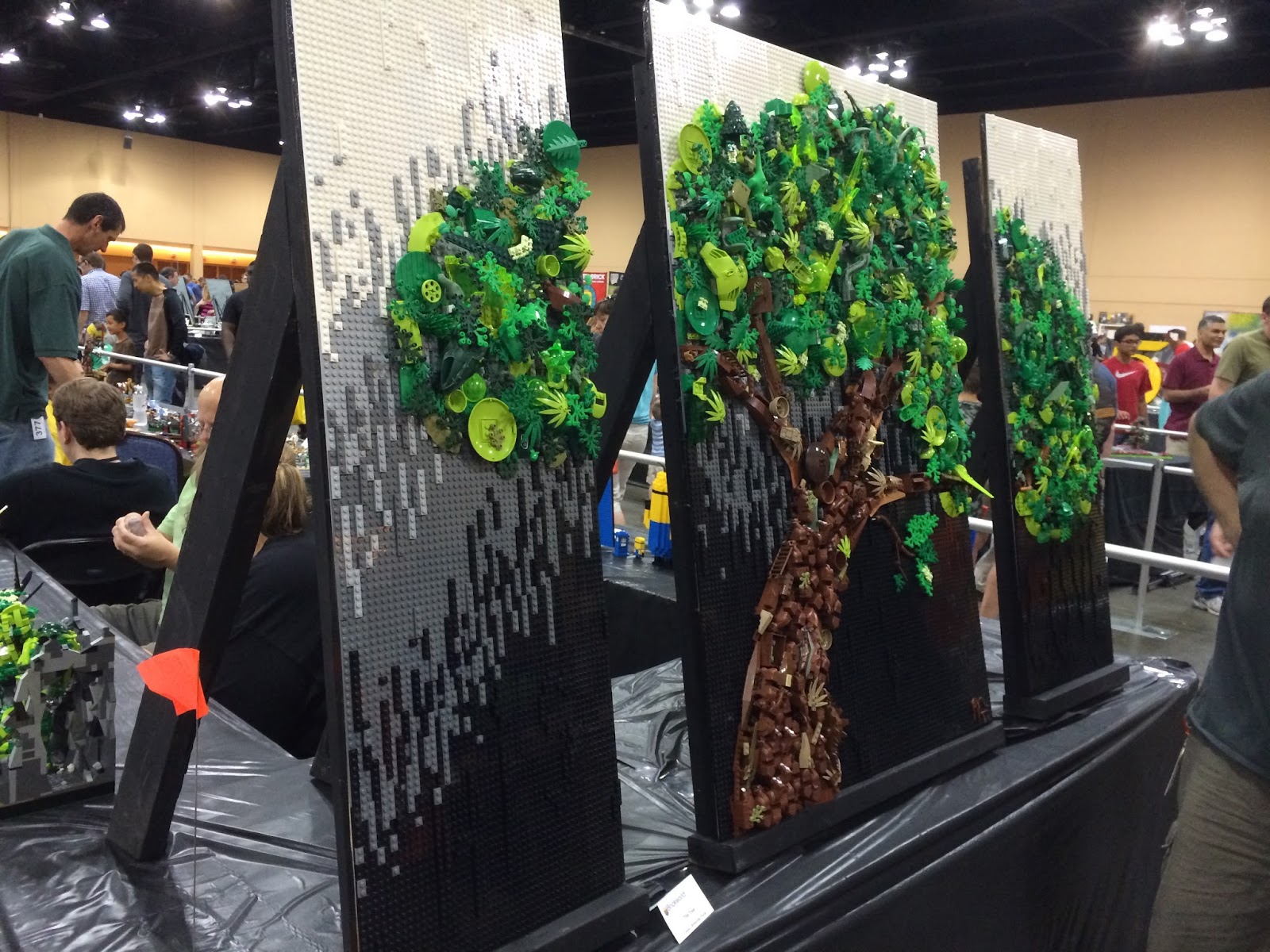
Lego Brickworld: Inspiration for Making

Over Father's Day Weekend, my husband was a trooper to take part of "his" weekend to spend with his geeked-out wife and two sons at the Lego Brickworld expo in Schaumburg, Illinois.  As an an older sister to a Lego fanatic, I have grown up with a deep respect for all things Lego--except for that awful moment when you step on a Lego in bare feet!  We visited the expo as a treat for our kids, who love this toy immensely, growing up first with Duplos and then graduating to the regular bricks.  I immediately discovered that this experience wasn't going to be just about my boys; it clearly was going to be a way for me to collect ideas and inspiration for my makerspace.

When we stepped into the expo, it was something akin to Charlie walking into the Willy Wonka Chocolate Factory--visually dazzling, buzzing, alive.  My jaw dropped, and I couldn't help but feel excited as well as a bit overwhelmed.  My family and I walked from table to table, each new innovative creation inspiring and amazing us--so many small details taken into account even in the largest of displays.  There was also something there for everyone; even if you weren't a fan of Legos, you left with a new-found respect for this toy.  What I also found interesting is the expo was much like a Maker Faire with an emphasis on Legos.  There were people from all different walks of life and skill levels there to share what they had created with the world.  Since I was there with my sons, who have finally reached the age when they will put aside the booklet for a kit and just build something from their imaginations, we saw this as an opportunity to get ideas, seek advice, and think about possibly showcasing some of their work at this expo in the future.  (My older son asks me if he can do this just about every day now.)

As much as I can try to describe what I saw, it's much better to share it through photos.  Of course there is no way to really truly capture the experience in photos either, but you'll see some of the cool things I observed while visiting the Brickworld expo.  All of these, as well as many others, have become true inspirations for me as I think about the Maker Movement and designing the makerspace in my learning commons.

There were many large cityscapes.

A QR Code made out of Legos--and it worked of course!  Super neat.

Lego Wall--How fun to leave your mark or create graffiti using Legos!

Lego flowers

Lego art--I would love several of these hanging from my learning commons' ceiling.

Paying homage to the popular '80s cartoon, The Smurfs!

A childhood classic: Where the Wild Things Are

Storybooks come to life with Lego characters

Lego art

Lego patterns

Lego mosaics

Lego Pop Art

As a Chicagoan, I love this one since it's a favorite of mine at the Art Institute and part of one of my favorite scenes in Ferris Bueller's Day Off.


Since attending this expo, my kids have been playing with their Legos daily, and I can't help but tinker a bit as well--especially with the idea of creating mosaics and QR codes!  I'm excited to find ways to bring Legos into my learning commons and help kids get charged up just as my family and I did at Brickworld.


Monday, June 22, 2015

A Chance of a Lifetime

It's taken me about a week to digest the fact that one week ago on Monday I was in the White House among leading American school districts discussing the Maker Movement and the future for students in our nation.  I was extremely fortunate to invited by my school district's innovative and inspiring superintendent, Dr. Mike Lubelfeld, as someone who would help lead our district in bringing more opportunities for making in our district.  I am forever grateful to him for this experience, which is, hands-down, a pinnacle in my 17 years in education.

Our two-day stint in D.C. began at a Maker Ed event.  I'll be honest here and confess that I had never heard of Maker Ed before attending this workshop on a Sunday afternoon.  After spending time with individuals from this organization for two days, I can't imagine not using their website and materials for help.   If you, too, haven't heard of them, Maker Ed is committed to supporting teachers and has a wealth of ideas and resources available on their website: http://makered.org/


(Definitely check them out!)  Besides finding this great group, I really enjoyed this Sunday afternoon committed to an authentic experience.  Sure, we read all about makerspaces and give our students experiences, but how often to educators get to sit down and play and experiment?  We were given close to an hour with our "Possibility Box" full of all kinds of doodads:


There were other items on our table as well--sheets of origami paper, LED lights, batteries, paper, poster board, etc.  There were also tables set up in the room with extra supplies as well as fun tools such as hammers and electric drills.

As creative as I think I am, I found myself a bit frozen when this started.  What was I going to make? There were so many materials available to me.  What inspired me?  I quickly found myself drawn to the lights and batteries and given that I had just spent time weeding and mulching my garden back at home, I felt the need to create my own little garden:

 
"How Does Your Garden Glow?"

And it got messy--messy and creative and collaborative and fun.  


It was interesting not only to work with these materials on my own, but also to watch others experiment and create.  Each table showcased such diverse, innovative, and amazing items--all from the same set of materials and options I had.  

What I found truly exceptional was experiencing a maker experience firsthand.  Not reading about it in some educator journal or observing students doing it.  I was doing it. And I was having a blast while solving problems and using my creativity making whatever I liked.

It's no surprise that I entered Day 2, the highlight of the trip with our visit to the White House, still floating from the day before.  I was revved up from the Maker Ed workshop and ready to discuss and learn more.  And, we certainly did just that!


The White House event was all I expected and more. (But, no, my dream of getting a selfie with President Obama didn't quite happen!) This roundtable event was the result of President Obama's call to action the year before:
https://www.whitehouse.gov/the-press-office/2014/06/18/fact-sheet-president-obama-host-first-ever-white-house-maker-faire


Representatives from different school districts around the nation shared highlights of the amazing makerspaces they have as well as the projects they were completing--truly an inspiration as I ponder what I would like my makerspace to look like come August and September.

We also had a chance to mingle and network.  I met people all across the nation from all walks of life--teachers in the trenches like me, district superintendents, representatives from museums and public libraries, President Obama's advisors, and even the creator of MAKE Magazine and Maker Faires around the globe.  These valuable interactions gave me even more ideas and helped me identify individuals I can turn to and rely on when I'm seeking resources or support.

The part I found most interesting were the lightning roundtable discussions.  We signed up for topics based on our interests.  I immediately chose community partnership because I felt this is an area we could improve upon in our district.  Quite frankly, we aren't connecting with our community members and community businesses, so I wanted to get some ideas in order to do so.  I left with two pages of notes and all kinds of great ideas to get me started. 

In the end, this was a two-day trip to D.C. I will never forget--a chance of a lifetime.  It truly was an honor and a privilege to represent Deerfield District 109 along with my superintendent at the workshop and roundtable discussion.  Most importantly, I feel equipped with connections, ideas, and resources to get started.  It's time to make my makerspace!